When you look at an elongated photo of our planet, the overwhelming amount of blue that you see may make it seem like we have unlimited water. This is not the case, because 96.5% of the water on Earth is contained in saltwater oceans and only 2.5% is freshwater, which is what can sustain life on land. Sixty-eight percent of freshwater is frozen in ice and glaciers and 30% is in the ground. This groundwater is a vital resource for all life, because besides the 1.2% of freshwater flowing in rivers and lakes, we heavily rely on groundwater for irrigation, drinking water, household use, and more.
Groundwater is stored beneath the Earth’s surface, in the saturated zone, which can be found directly under the ground or up to hundreds of feet down. The unsaturated zone is above it and acts as a transit route for water as it moves into the saturated zone. Roots and microbiota live in the unsaturated zone and they require little air pockets between the soil/rock particles to survive. The saturated zone does not sustain nearly as much life as the unsaturated zone does, allowing for the little pores between sediments to be completely full of water. This makes it the perfect home for the world’s groundwater!

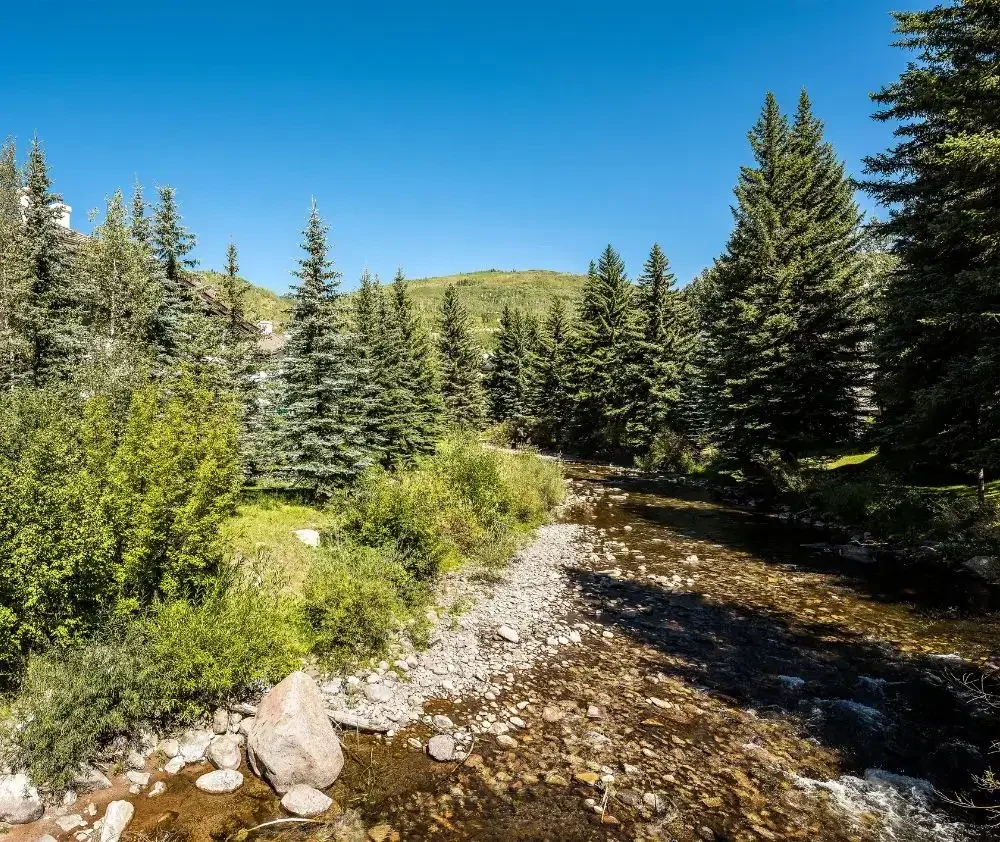
Gore Creek is directly connected to the underground aquifer that provides Vail’s drinking water, making a healthy watershed essential for both people and wildlife. 📷 Licensed from Adobe Stock.
When these zones of saturation are large enough to provide water for springs and wells, they are called aquifers. Humans can extract groundwater from aquifers by drilling into the ground until we hit the saturated zone, creating a well, and using pumps to draw the water up to the surface. Specific types of rocks, such as sand and gravel deposits, sandstone, limestone, and fractured crystalline rocks, are more likely to form aquifers. Varying geology and rock types across regions cause aquifers to come in all shapes and sizes, with some taking much longer to refill with rainwater than others. Since no aquifer is the same, regulating how much water is being pumped out of an aquifer is very complicated. Excess pumping can disturb delicate recharge systems and eventually even cause the aquifers to run dry.
Two of the largest and most significant aquifers in the state of Colorado are the Denver Basin Aquifer System and the San Luis Valley Aquifer System. These large aquifers often support large-scale irrigation and are called confined aquifers because the saturated rock layers are bound by layers that water can’t get through. However, these aquifers do not supply water for the Eagle Valley. Another aquifer type, the alluvial aquifer, is formed through the deposition of sand and gravel as rivers slow down or change course. These loose sediments are called alluvium, and groundwater fills up the pore spaces to create the aquifer. The town of Vail’s primary water source is called the Gore Creek Alluvial Aquifer. This aquifer is approximately 100 feet deep and is hydraulically connected to the Gore Creek. The five wells that are drilled into the Gore Creek Alluvial Aquifer can produce up to 7.5 million gallons of water per day.
Alluvial aquifers are extremely responsive to their surrounding environment. They are relatively shallow and highly porous, so they do interact directly with surface water. In general, alluvial aquifers are recharged from local precipitation and river infiltration, so in the case of drought these aquifers are at risk. During droughts or years with below-average snowpack, less water enters both the creek and the aquifer, making water conservation especially important. We had an extremely dry winter in Colorado, resulting in the Town of Vail implementing an outdoor water use reduction for the summer. The goal is to keep as much water as possible in the Gore Creek, the Eagle River, and the aquifer, and also to assure that our indoor water supply is adequate. Please avoid excessive lawn watering to make sure that you are conserving as much water as possible to keep our local aquifer healthy during this drought.
Elsie Lindsay is a Naturalist at Walking Mountains.