
What makes us consider a living thing a “pest” or less valuable than others? Often, it comes down to two things: the frequency with which we interact with the living thing and the utility they provide for us. Take an invasive weed, for example. What is a dandelion if not just a flower growing in an unwanted space? I once worked with a farmer who constantly waged war against dandelions for colonizing our (also non-native) grass fields. If the farmer took time to learn about dandelions- an essential food source for pollinators with deep root systems that improve soil health- perhaps he would change his mind about their “value”.
What if instead of their perceived utility, we valued the intelligence and adaptivity of creatures? In his book, Botany of Desire: A Plant’s Eye View of the World, Michael Pollan recounts human history from the perspective of plants, crediting the crafty creatures with manipulating us into passing on their genes, thereby single-handedly (leafedly?) shaping agrarian culture. It is a worthwhile exercise to shift our anthropocentric perspective. Under Pollan’s reasoning, the plants and animals most abundant and intertwined with human communities are also the most valuable.
Consider a ubiquitous nuisance bird species in our valley: the black-billed magpie. Occasionally, students will express a particular contempt for this common corvid. I prod the accuser for reasoning… “they are loud, annoying and everywhere” -or worse- “my parents hate them”. Well, curious reader, I am here to convince you that magpies are delightful, remarkable and worthy of our respect- nay, reverence. We here, at Walking Mountains, are pro-magpie!
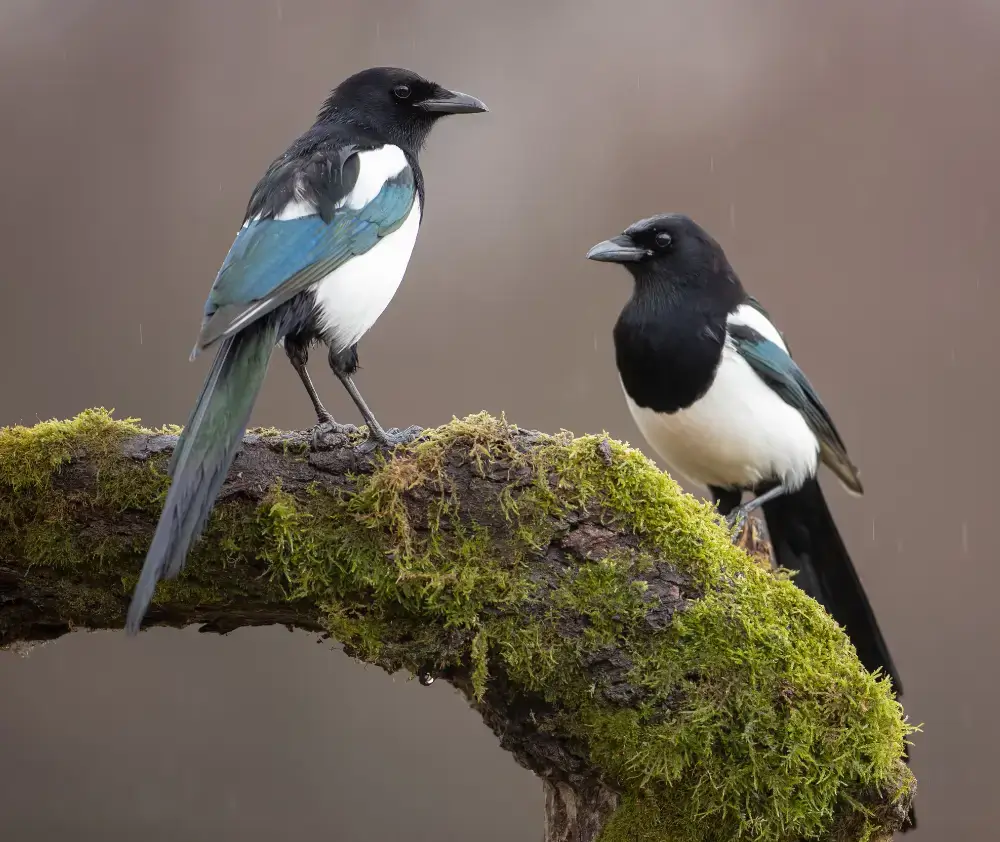
Two Magpies on a moss-covered branch in winter. 📷 Licensed from Adobe Stock
Often on my morning walk to the office, I idle in the envelope of overgrown willow trees, who safeguard a vibrant community of magpies. I wouldn’t lie to you, the campus magpies are always up to something. Once, I saw two magpies sharing a branch, touching bills and rapidly chittering back and forth to one another- a display of language and behavior that I can only describe as flirtation. After the couple clocked my entitled observations, they quieted immediately and returned to separate perches. I apologized for my intrusion, so as not to offend. According to the Cornell Lab of Ornithology, magpies are known to mate for life, recognize human faces and hold grudges.
My colleague once observed a large group of magpies in circle formation- a behavior well researched and documented. Magpies are known to host funerals. Once a magpie discovers dead kin, they call out for attendees to congregate, bringing offerings of grass. This rowdy gathering lasts for several minutes until the group silently disperses.
Magpies’ social tendencies are not discriminatory. Another colleague recalls a story about a magpie, a dog, and a dead deer. During a hunt, her dad was led to his downed deer by a magpie repeatedly dive bombing his Labrador. As scavengers, magpies rely on predators because their beaks cannot penetrate the hide of a fresh kill. This collaborative magpie was urging the dog (recognized as a wild canine) towards the carcass so the pooch could break bread (flesh) with the bird.
Magpies encourage us to question our assumptions about the value and intelligence of the natural world. If I succeeded at my job as a parrot for magpie-kind, you will engage in some research of your own -and no need for books! On your next walk, equipped with this knowledge and appreciation, give these remarkable teachers a moment of your attention.
Annie Henderson is the Graduate Programs Manager at Walking Mountains and enjoys breaking down philosophical ideas with the Foley Graduate Fellows in their weekly classes about nature, humans and how the two intertwine.