
When enjoying time outdoors in the Vail area, you do not see the variety of reptiles you might encounter when visiting other parts of the country – Why is that?, With the high elevation , cold temperatures, and short summers, most of our cold-blooded friends could not thrive in the mountains. As endotherms, reptiles cannot generate body heat through metabolism alone. They typically rely on the environment to regulate their body temperature. Historically the harsh mountain climate makes it difficult for reptiles to survive here, but there is one snake species that has some tricks up its sleeve to reside in the valley.
If you have encountered a snake on the trail up here, there is a very high likelihood it was a garter snake. The wandering garter snake (thamnophis elegans vagrans) is characterized by a neutral base color and a checkerboard pattern of dark spots between cream/yellow strips. They are commonly found near waterways and moist meadows, but have been found in drier open-space and as high as 13,100 feet! So what sets them apart from other snakes that cannot call Colorado home?
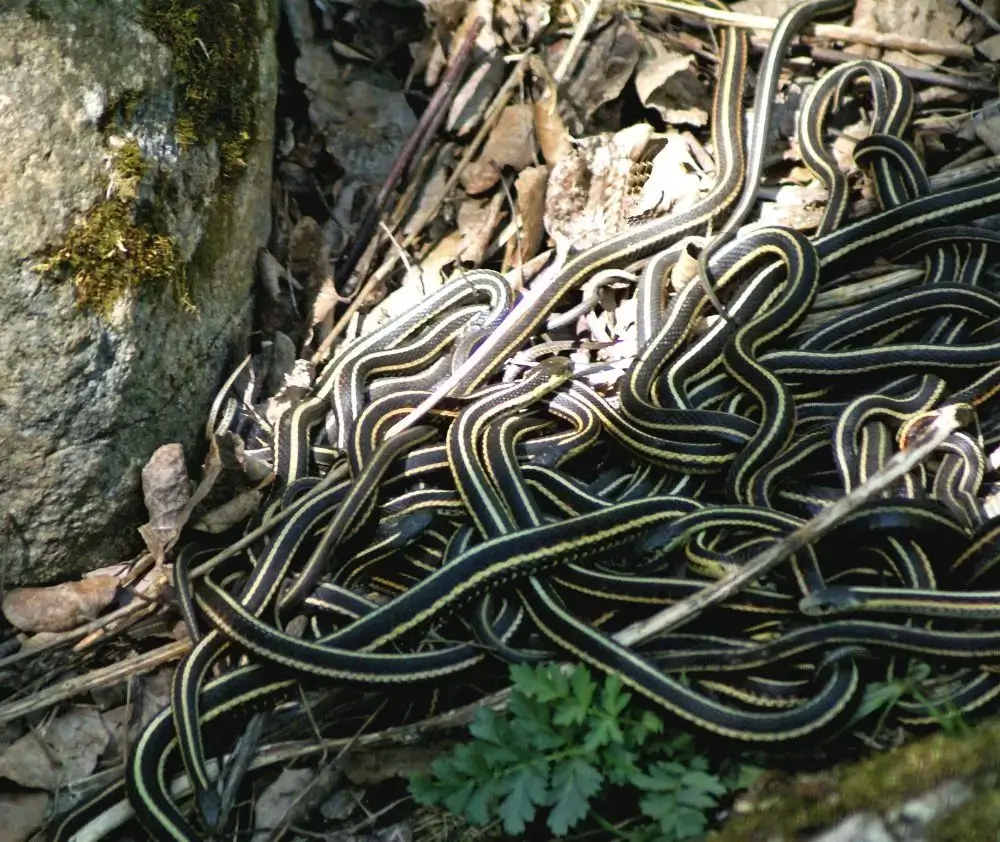
A den of wandering garter snakes. 📷 Licensed from Adobe Stock.
One special adaptation of garter snakes is internal incubation; a process where embryos develop inside eggs that the mother carries for 2-3 months. While the majority of snake species lay eggs. Garter snake reproduction is considered a live birth, and offspring are independent once they emerge from the egg sack. With births of 15-40 young at a time, the numbers and self-sufficiency are on their side when it comes to survival. The most helpful survival tactics for our climate, however, is communal brumation. This is essentially a giant cuddle puddle; a large group piles inside a burrow to share heat and conserve energy to survive freezing temperatures. This has allowed the garter snake to maintain an impressively large range from southern New Mexico to south western Canada. Few snake species today can claim such adaptability in North America, but in the coming decades range expansion may be a reality for many. Recent climate change studies have sparked conversation around how various snakes and lizards will be driven to new regions, including our mountainous backyards.
Climate projections show regional warming trends in the west, making it feasible for reptiles from warmer areas to survive further and further north. A study published in October of 2024 by the United States Geological Survey looked at 130 lizard and snake species across the United States and northern Mexico, and reported “by the end of the century, 68% of the 130 species are predicted to have an expanded climate-niche distribution, potentially resulting in new species arriving across state and international borders if there are no barriers to dispersal”. Colorado and Idaho are theorized to be the states receiving the most new residents, given they are bordered by desert ecosystems. But even with the seemingly positive outlook, not all species will find a new place to go. Approximately 8.5% of the studied species are predicted to experience habitat loss; their niche climates becoming too hot and dry for survival.
Today, only eight types of snakes and lizards call Eagle county home. As conditions become better suited for reptiles in the mountains, we will need to pay attention to who is making it to new heights and who is getting squeezed out of their habitats. These projections are a meaningful reminder that with accelerated climate change there are no true winners. Every expansion of one species means added pressure for another. Well adapted species like the garter snake may fair better but these climactic changes will be felt by all life.
Sarah Brookins is a naturalist at walking mountains and if she were to be a reptile, she’d be a Sunbeam Snake (Xenopeltis unicolor).
Sources
http://www.coparc.org/wandering-gartersnake.html
https://www.critterdetective.com/nuisance-animals-that-are-adapting-to-city-life
https://phys.org/news/2021-06-rattlesnakes-climate.html
Climate futures for lizards and snakes | U.S. Geological Survey
https://arcprotects.org/restoring-a-desert-oasis-to-bolster-narrow-headed-garter-snake-populations/