

Do you ever wonder why birds sound the way they do? Approaching summer, we’ll all be getting used to hearing birds chattering and squeaking a little louder. When a bird sings, it is communicating myriad information to other birds, such as where its territory is, if its available for mating, or warning of danger. In the avian world, habitat works as an instrument alongside birdsong, and the structure of the landscape decides how the music is written.
The pitch of a bird’s call is a response to how sound waves interact with its surroundings. While high-pitched sounds are easily blocked by leaves and twigs in dense vegetation, low-frequency calls can move through obstacles. Take the deep, slow hoo of the Great Horned owl. Used to find mates and defend their territory, owl calls need to travel great distances. The low-pitched call of the owl produces sound waves that are physically long, and can get past obstacles like leaves and tree trunks. Longer sound waves can move around the edges of anything getting in their way and continue forward. The call of an owl can be heard from over half a mile away, even in dense forests.
Alternatively, birds that live in open grasslands and prairies tend to have much higher-pitched, intricate calls and songs. There are far fewer tree trunks and dense leaf canopies to block sounds. High-pitched sounds are more precise and can carry more information, so birds like the Western Meadowlark pack their calls with quick notes and intricate shifts in pitch. These narrow sound waves cut straight across the open field, allowing the bird’s intricate message to travel vast distances without distortion.
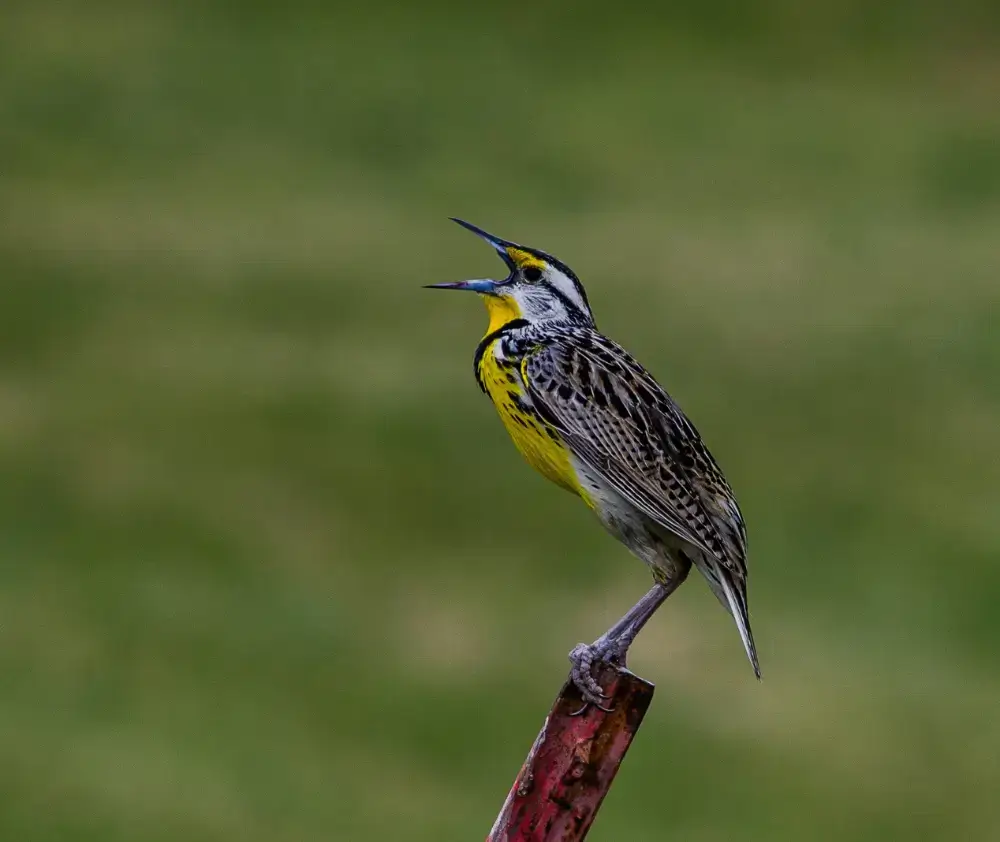
(📷 by Jeffrey Hamilton on Unsplash)
Bird sounds aren’t just hindered by obstacles in the forest, however. Some birds have learned to utilize natural features to amplify their messages. The Northern Flicker, along with the Hairy and Downy Woodpeckers, are local residents who use snags, or hollowed-out trees, to communicate. They are all known to drum on these snags, whose hollow bodies act as an amplifier, to transmit messages long distances.
Over generations, each species of bird has adapted to take advantage of the specific landscapes they live in. As human development reshapes the landscape, it introduces artificial architecture that disrupts these well-established strategies. The obstacles change from soft, absorptive leaves to reflective surfaces like concrete and glass. Urban materials create harsh echoes that interrupt a bird’s signal. The constant sound pollution of urban life also poses a challenge for birds. The city’s constant low-frequency noise acts as a wall for a species like the Great Horned Owl, masking their signals entirely. A recent study found that urban blackbirds in Vienna have to sing 2.5 decibels louder than their local forest-dwelling counterparts. When comparing just the most commonly used pitches by the two populations, that difference more than doubles to 6db, accounting for a change in volume of almost 10%. Birds that have spent millennia perfecting communication for a specific natural niche are now struggling to be heard through a human medium that is both louder and more reflective than any forest.
Vocalizations heard on our trails are more than just a soundtrack. They are functional tools built to work within a specific physical landscape. When we alter the architecture of a habitat, we change the very medium these species rely on to communicate. To protect these birds, we must preserve the acoustic integrity of the environments they were engineered for. By advocating for the conservation of our local wild spaces, we ensure that the natural world remains a place where these signals can still be sent and received.
Andrew Craig is the Lead Naturalist at Walking Mountains, where he loves eavesdropping on local wildlife.
Sources:
https://www.audubon.org/magazine/how-birds-habitat-influences-its-song
https://www.sciencedirect.com/science/article/pii/S2351989425005451
https://besjournals.onlinelibrary.wiley.com/doi/10.1111/j.1365-2435.2006.01207.x
https://pmc.ncbi.nlm.nih.gov/articles/PMC3574330/#RSPB20122798F1