
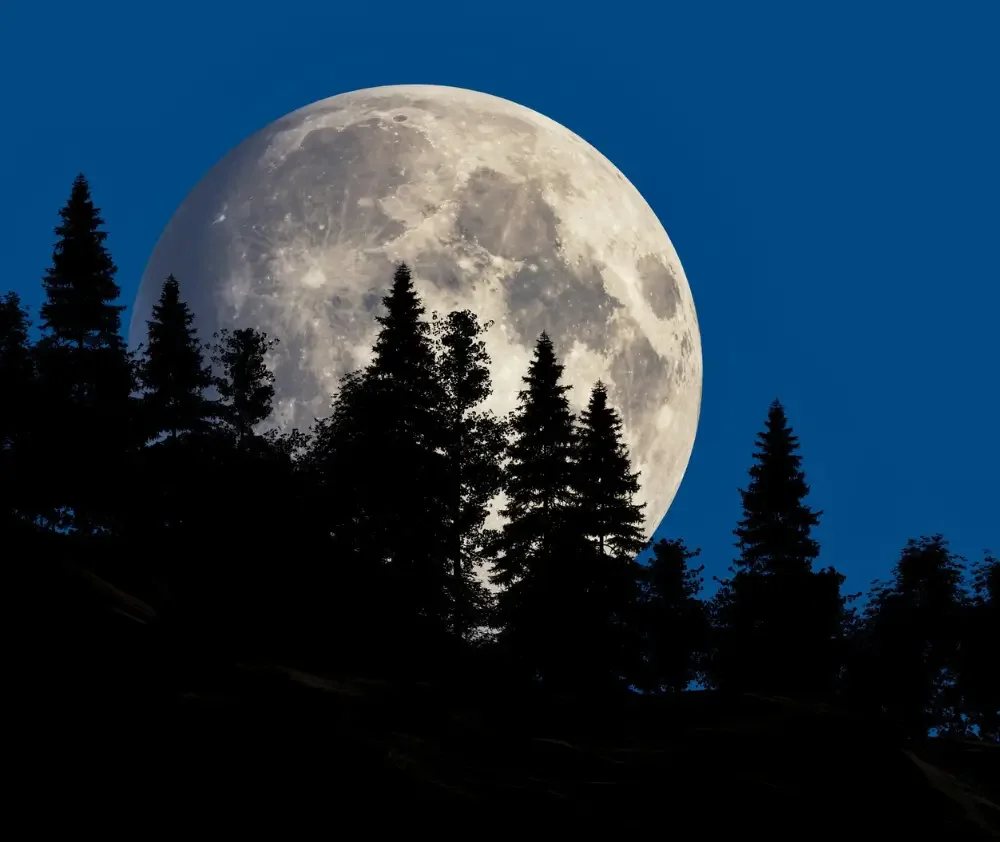
For thousands of years, celestial bodies have inspired common phrases we still use today. “Over the moon” expresses how elated one is, and “stellar” could be used as an adjective for something totally awesome. However, there is one star-dusted idiom that is not as self-descriptive as the others – “Once in a blue moon,” used to describe exceptionally rare occurrences. What exactly is a blue moon? Is it actually blue, and are they even rare at all? Let’s take a closer look at this phenomenon and when to view it.
The seasonal blue moon
Let’s start by breaking down the seasons. There are four astronomical seasons in the year, each defined by its respective equinox (spring and fall) or solstice (summer and winter). Usually, there are three full moons per season, equalling out to about 12 per year. However, the cycle of the moon is 29.5 days – shorter than all months of the year (minus February). Because the cycle of the moon doesn’t match up perfectly with the calendar months, sometimes there will be an extra full moon per season – so four full moons instead of three. Here lies the traditional definition of a blue moon: The third full moon occurring in a season with four full moons.
The monthly blue moon
The second definition of a blue moon arose from a misunderstanding of the traditional one and has become the most commonly used definition. It is used to refer to the second full moon in the month. Again, the moon cycle is shorter than most months, so occasionally there may end up being two full moons in one month.
By now, you may be wondering when the next blue moon will be. Surprise – it’s today, May 31, 2026! Today’s blue moon is a monthly blue moon, the first full moon having occurred on May 1. It also happens to be the most distant full moon of 2026, referred to as a “micromoon.” This means tonight’s blue moon is at or near apogee – the farthest point from earth in its elliptical orbit. It will appear about 7% smaller than an average full moon, and 12-14% smaller than a full supermoon.
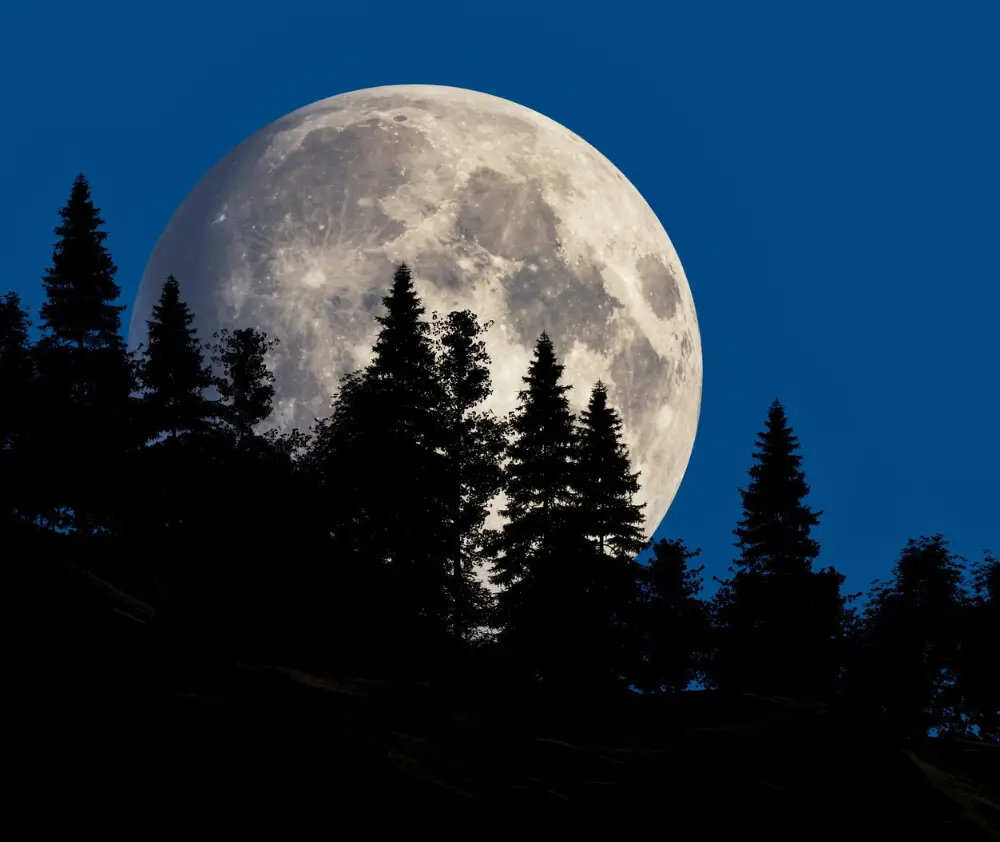
Night settles over the forest as the full moon lights up the sky. (📷 by Igor Omilaev on Unsplash)
The literal blue moon
There is a third and more literal definition of a blue moon, referring to occurrences where the moon actually looks blue, due to dust particles in the air scattering red light away from the moon and giving it a blue hue. These occurrences are extremely rare. You could say they happen only every “once in a blue moon” (ha!). One major example of this happened in 1883, when a volcano in Indonesia called Krakatoa erupted and spewed ash 50 miles high into the air. Since then, other volcanoes have erupted and caused blue moons, including the El Chicon volcano in Mexico in 1983, Mt. St. Helens in Washington State in 1980, and Mount Pinatubo in the Philippines in 1991.
Look up!
So maybe blue moons aren’t as rare as we thought – but they are still rare! They only occur roughly every two to three years, which means that only six percent of full moons are blue moons. The last monthly blue moon happened on August 31, 2023, and the last seasonal one followed on August 19, 2024. The last recorded actual blue moon, though, happened nearly 34 years ago with the eruption of Mount Pinatubo. Although a blue moon isn’t necessarily an exceptionally rare occurrence, the next one won’t be until May 2027, so go take a look tonight if you get the chance!
Callie Pehl is the Development Coordinator at Walking Mountains and loves all things astronomy – especially the moon!
Sources:
https://www.almanac.com/what-blue-moon
Super Blue Moons: Your Questions Answered